CREATIVE.NOTES / MUSIC × SYSTEMS
2026.09.21 / MD STUDIO · OPEN SOURCE
Press play on who you were ten years ago.
Keeping music, one season at a time. Introducing MD Studio.
Sometimes, while writing music, I cannot find the next note. On those days I occasionally reach for an old MD. What was I listening to at this time ten years ago? What was popular then, and what was I writing?
Pressing play brings back more than the songs. I hear the sounds I was drawn to, arrangements I might no longer choose, and a taste that was still taking shape. A small disc gives me another way into the ears of my earlier self. Quite a few new ideas have started with that kind of listening.
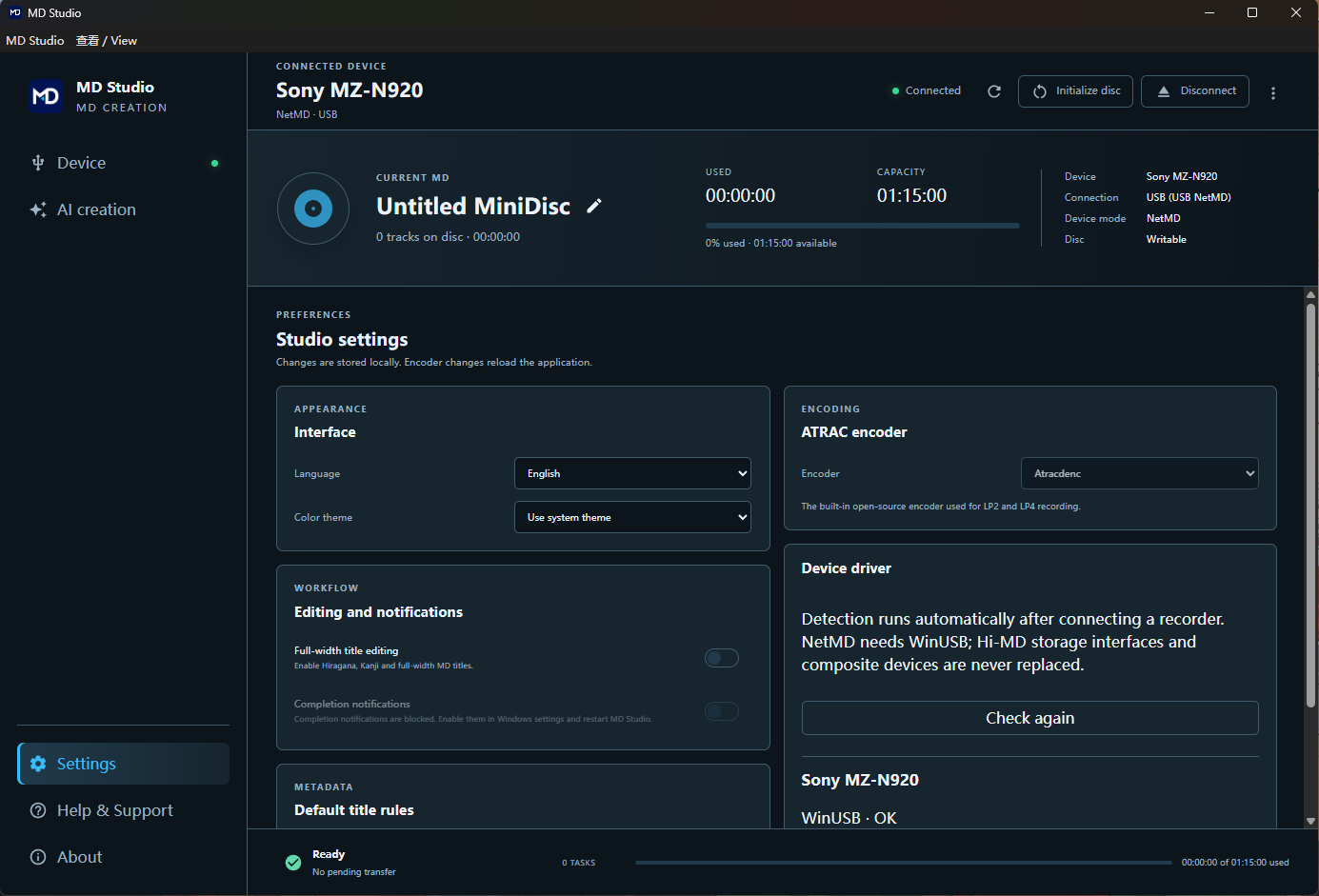
MD Studio grew out of this personal habit. I wanted a tool that still mattered to my creative life to remain comfortable to use. Building on an existing open-source project, I reworked the recording workflow and interface, then added a way to make MDs with help from AI.
A season, gathered onto a disc.
For a long time, I have made music archives by year and quarter. They bring together the popular songs of that period, the music I played repeatedly, and pieces I wrote myself. Sounds that passed through my life at the same time stay together.
Choosing and sequencing them gradually gives a season its outline. What the world was listening to, what fascinated me, and what I was trying to make become audible beside one another. Returning later, I can hear the distance between those things, and the ways they influenced each other.
Limited space suits this practice. Which tracks should stay? What should follow what? Those small decisions give a collection its character. Years later, they also give me a reason to take that particular disc off the shelf.
Enough room for the files. A way back to the time.
A single computer can now hold thousands upon thousands of songs. That convenience is remarkable. But finding “what my ears were living in ten springs ago” is a different task from searching for a title. Keeping a file and having a reason to listen to it again can be surprisingly far apart.
There is no universal number of years an HDD or SSD will last, and an MD is not a permanent medium either. Original recordings and project files still need multiple backups. Alongside those, an MD gives me a way to keep a period of music as a collection I can return to and hear as a whole.
Cassettes and CDs each have their appeal. MD is digital, smaller than a CD, protected by its cartridge and easy to put away. I enjoy the sound. For the particular way I choose, keep and revisit music, this little format still fits exceptionally well.
Old sounds can open the next song.
Music sometimes moves like fashion: a sensibility leaves the foreground, then returns in another form. The swing of a rhythm, the texture of a synthesizer, the space around a vocal can become compelling again. There is no fixed timetable, but hearing an earlier recording in a new context can reveal possibilities I had missed.
Listening back also reconnects me with earlier creative decisions. How would I develop that passage now? Could the sound that once fascinated me work somewhere quite different? A small question can be enough to get a stalled piece moving. This connection to making music is a large part of why I keep using MD.
The people who use a tool can carry it forward.
MD, once a familiar part of listening in Japan, has moved out of the mainstream. Sony ended downloads of SonicStage CP in 2013 and production of recordable MD media in February 2025. The official paths for continuing to use these machines with newer computers have grown much narrower.
A community of developers has helped bridge that gap by studying the devices and sharing its work. asivery’s Web MiniDisc Pro, together with the projects behind NetMD and Hi-MD support, makes it possible to keep making discs on current computers. MD Studio depends on that accumulated work.
My contribution concentrates on the everyday recording workflow, the interface, and access for AI assistants. MD Studio retains the upstream credits and licensing and is itself released under GPL-2.0-only. Sharing the improvements leaves a starting point for the next person who still has a use for these machines.
More time choosing music. Less time typing labels.
One unexpectedly laborious part of making an MD is entering its labels. Track titles, disc names and group names all need attention. With Japanese music, I also want half-width katakana readings for the standard titles and the original Japanese, including kanji, in the full-width fields. Source tags vary; sometimes all I have is a filename.
MD Studio exposes this work through MCP and CLI, so a compatible AI client can participate directly. I can tell an assistant such as ChatGPT where the local music is and how I want it arranged, then ask it to organize the titles, readings, order and groups. The included Skill explains MD text and field rules, including the distinction between standard MD and Hi-MD.
The important change is being able to begin with one ordinary request and connect it to many small operations. Unusual names and uncertain metadata still deserve a check. AI prepares a plan; I review and adjust it, then ask for the recording. The same order and progress remain visible in the app, keeping attention on the collection I want to make.
A request might begin like this.
Arrange the music in this folder in track order and prepare an LP2 MD. Use half-width katakana readings for standard titles, keep the original Japanese in full-width titles, and group by album. Show me uncertain readings and the capacity estimate before I approve recording.
AI access requires a client that supports local HTTP MCP or running the local CLI. Audio conversion and device communication run on your computer; text and metadata shared with AI follow your client’s privacy settings.
I intend to keep using MD Studio and add practical improvements as real needs appear. Making a collection at the end of a quarter should feel like a natural part of listening. A recorder someone still loves should be easier to bring into their present-day routine.
Years from now, when another song refuses to come together, I may reach for the disc I make today. Sounds so familiar that I barely notice them now will return with the distance of time. There may be the beginning of another song somewhere among them. I want to keep making room for that encounter.
A season kept on a disc may become the beginning of a song yet to be written.
千弦 / Chizuru
OPEN SOURCE / GPL-2.0-only
MD Studio v1.0.0
A free, open-source Windows app in English, Japanese and Chinese. The installer, user manuals and AI connection guide are available now.